
Lessons from my first multi-country clinical trial in maternal health research India
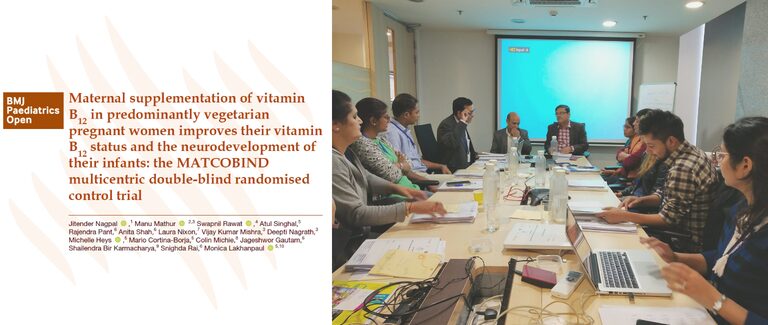
I still remember the day in 2017 when MATCOBIND was not a ‘trial’ at all—just a conversation in a small room at the Public Health Foundation of India. We were doing what research teams often do: testing ideas against evidence, feasibility and the kind of questions that can realistically be answered well. One question kept circling back to me: if we improve vitamin B12 deficiency in pregnancy, can we shift a baby’s neurodevelopment even slightly in a setting where vegetarian diets are common and deficiency is frequent?
What I didn’t fully understand then—at least not emotionally—was that this would become the first multi-country, internationally funded clinical trial I would undertake. That mattered, because it meant learning a new kind of leadership: not just scientific, but operational, ethical and human—within the broader context of global health research funding and maternal and child health outcomes.
Part of the motivation was science and part was a persistent question that data kept raising. Years earlier, we had completed work linking antenatal physiology with later neurodevelopment at 9–12 months. That work, along with published evidence linking maternal micronutrient status to infant neurodevelopment, kept pointing to the possibility that developmental trajectories in our setting may fall short of global benchmarks—and that this gap might be partly modifiable.
This is particularly relevant in the context of micronutrient deficiency South Asia, where nutritional gaps continue to impact early childhood development outcomes. Vitamin B12 kept appearing as a plausible lever because it sits right at the centre of neurogenesis and myelination and deficiency is common where animal-source foods are limited.
As we explored the literature, the evidence felt mixed and sometimes frustrating. Some trials suggested benefit, others did not. Again and again, one hinge emerged: dose. Recommended daily allowances are tiny; deficiency correction often uses much higher doses. Earlier maternal supplementation work suggested lower doses could prevent deterioration in pregnancy, but might not produce meaningful biochemical improvement—especially when baseline deficiency is substantial.
That’s what shaped MATCOBIND. Instead of a classic placebo-controlled trial, we chose what felt ethically and scientifically defensible: comparing 250 µg/day versus 50 µg/day of oral methylcobalamin, starting in the first trimester and continuing until six months postpartum.
This design aligns with a maternal nutrition intervention approach aimed at generating evidence-based maternal healthcare insights in real-world settings.
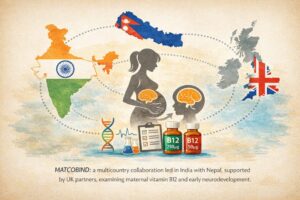
Then came the multi-country reality. Through a Newton Fund–supported collaboration linking India, Nepal and UK partners, the trial ran across two very different maternity centres: Sitaram Bhartia Institute of Science and Research in New Delhi and Paropakar Maternity and Women’s Hospital in Kathmandu.
In the abstract, multi-country trials sound inspiring. In practice, they are built on relentless attention to details—ethics approvals across jurisdictions, governance, reporting, training, standardisation and the daily choreography that prevents small slips from turning into systematic bias—critical elements in clinical trial maternal nutrition studies.
International funding also introduced me to expectations that we don’t always foreground in Indian clinical research: capacity building, patient and public involvement and pathways to impact. MATCOBIND’s public involvement wasn’t symbolic. Parents reviewed participant-facing materials and follow-up plans and qualitative work with pregnant women helped us understand barriers and motivators—leading to practical changes in communication, consent flow, reminders and reimbursement strategies to improve retention.
This kind of work is increasingly essential for securing public health research grants and demonstrating readiness for maternal health funding opportunities.
But the hardest lessons weren’t learned in meetings or manuscripts—they were learned in the messy middle of trial conduct.
I felt real frustration at times: when the pharma company delayed dispatch of supplements and timelines threatened to slip; when recruitment at the Nepal site was slower than expected; when COVID prevented some mothers from receiving supplements on schedule despite our best efforts.
COVID forced protocol adaptations—teleconsultations, home-based services, increased capsule dispensing and extending infant follow-up up to 12 months. None of that felt like “research” in the way we romantically imagine research. It felt like keeping a fragile bridge standing while the river rose—while still maintaining the integrity of a scalable maternal health intervention.
And then there were the blood samples. Arranging the transport of samples from Nepal to India—preserving cold chain integrity, managing timing, paperwork and accountability—was genuinely nerve-racking. Our biochemical analysis depended on standardised processing and storage at sites and later batch testing; any break in those steps could turn months of careful work into noise.
What carried us through, more than anything, was the resilience of the team.
I watched Dr Swapnil Rawat, Dr Neetu Bansal and Mr Ramasheeh, along with a deeply committed research and clinical team, continue to work—day after day—through COVID’s uncertainty, maintaining follow-up, solving problems on the ground and sustaining participant trust when fear and fatigue were everywhere.
Many colleagues who supported data collection and continuity during the COVID era are acknowledged in our paper, but living through it made me understand something simple: clinical trials do not succeed on design alone—they succeed because of resilient teams delivering on complex maternal health research in real-world settings.
Their work reflects the kind of on-ground execution required to translate research into scalable public health interventions.
When we finally looked at outcomes, the effect size was modest—and in its own way, that felt believable. Among 531 mother–infant dyads, infants of mothers receiving 250 µg/day had higher mental developmental quotient (DQ) scores at 9–12 months than those receiving 50 µg/day—about a 2-point difference, translating to roughly an 8-centile shift—while motor DQ did not differ significantly. Maternal biochemical B12 status improved in both groups but more in the higher-dose arm, with good adherence and no major safety concerns.
These findings contribute to growing evidence in infant brain development research and prenatal nutrition brain development, particularly in low-resource settings.
One nuance stayed with me: when we stratified by country, the mental DQ benefit was statistically clear in India but not in Nepal. Earlier in my career I might have seen that as disappointment. Now I see it as an important reminder that nutrition does not act in isolation.
In settings where multiple deficiencies and socioeconomic adversity coexist, improving a single micronutrient may not be enough—highlighting the need for low-cost healthcare interventions in India that are multi-dimensional and scalable.
If MATCOBIND taught me one enduring lesson, it is this: running a trial is harder than designing one because reality is always part of the method. And for me, leading my first multi-country, internationally funded trial was humbling in the best way—it made me value the systems, the people and the persistence that turn a scientific question into evidence we can trust.
This research contributes to global maternal and child health research and underscores the urgent need for nutrition intervention funding and maternal health funding in India and South Asia to support scalable, evidence-based interventions that can improve early life outcomes.
Related publications from the MATCOBIND trial
- MATCOBIND main paper (open access): https://bmjpaedsopen.bmj.com/content/10/1/e004112
- MATCOBIND protocol paper: https://bmjopen.bmj.com/content/10/5/e034987
Author biography
Dr Jitender Nagpal is a pediatrician, public health researcher and Deputy Medical Director at Sitaram Bhartia Institute of Science and Research, New Delhi. He led the MATCOBIND trial—one of the first multi-country, internationally funded studies in maternal and child health research—focusing on maternal nutrition and infant neurodevelopment.
